

GST has four parts: CGST, SGST, IGST, and UTGST. Each part has its own role in taxes. Businesses can use mygstcalculator.com to figure out their GST. This makes following the rules easier.
GST has made taxes simpler for businesses. It has cut down on the hassle and cost of taxes. Knowing about GST helps businesses understand taxes better.
Key Takeaways
- GST is a comprehensive indirect tax that simplifies India’s tax structure.
- The four components of GST are CGST, SGST, IGST, and UTGST.
- mygstcalculator.com is a useful tool for calculating GST liabilities.
- GST has reduced the complexity of the tax system.
- Understanding GST components helps businesses navigate the tax landscape.
Understanding the GST Framework in India
GST has changed India’s indirect taxes for the better. It makes taxes simpler and more efficient. To get it, we need to see how it evolved, what it brought, and its parts.
The Evolution of Indirect Taxation in India
Before GST, India’s taxes were a mess. Many taxes were charged by both the center and states. This caused taxes to pile up, making things more expensive. GST fixed this by creating one tax for goods and services.
One Nation, One Tax: The GST Concept
The GST idea is simple: “one nation, one tax.” It aims to unite the country under one tax. By merging different taxes into one, GST cut down on the tax burden and made things clearer.
The Four-Tier Structure of GST
The GST system in India has four parts: CGST, SGST, IGST, and UTGST. Knowing these is key for businesses to follow GST rules.
| GST Component | Description | Applicability |
|---|---|---|
| CGST | Central Goods and Services Tax | Intra-state transactions |
| SGST | State Goods and Services Tax | Intra-state transactions |
| IGST | Integrated Goods and Services Tax | Inter-state transactions |
| UTGST | Union Territory Goods and Services Tax | Transactions in Union Territories |
This four-tier setup makes the tax system better. It handles different kinds of transactions across the country well.
CGST, SGST, IGST, and UTGST: What They Mean and How They Differ
The GST system in India has four main parts. They help make taxes clearer for both local and cross-state deals. Knowing these parts is key to understanding taxes on goods and services across the country.
Central Goods and Services Tax (CGST)
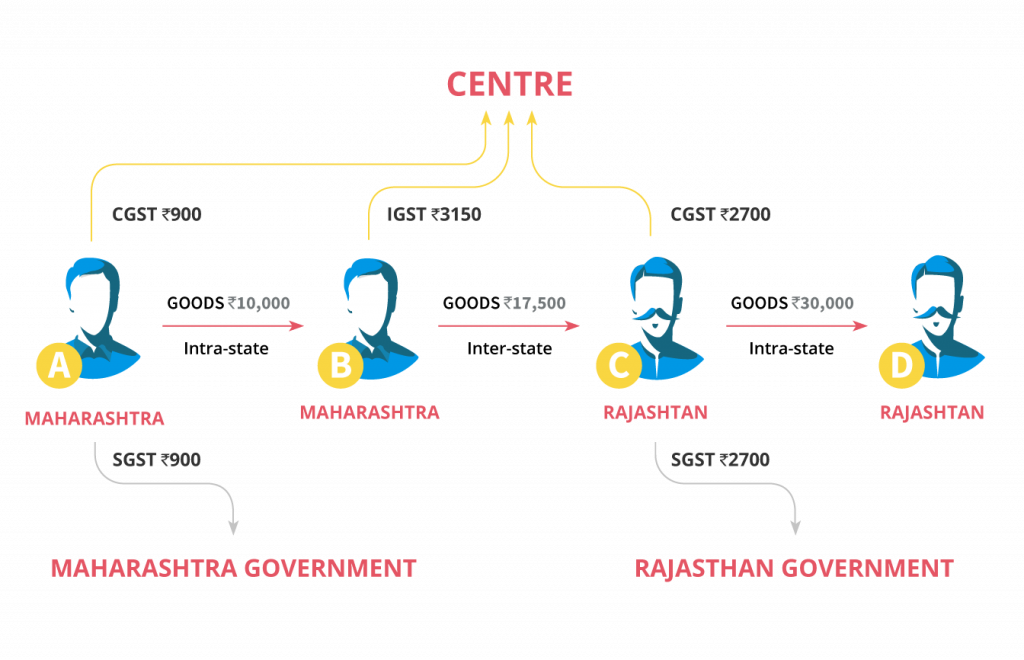
CGST is a tax from the central government for local sales. For example, if a business in Delhi sells to another in Delhi, CGST applies. The money from CGST is split between the central and state governments. If the GST rate is 18%, it’s split into 9% for CGST and 9% for SGST.
State Goods and Services Tax (SGST)
SGST is a tax from the state government for local sales. It works with CGST. For instance, selling goods in Delhi also gets you SGST, in addition to CGST. The state keeps the SGST money.
Integrated Goods and Services Tax (IGST)
IGST is for sales across state lines. Say a business in Maharashtra sells to someone in Gujarat, IGST is charged. The IGST rate is the CGST and SGST rates added together. The money from IGST is split between the central and state governments.
Union Territory Goods and Services Tax (UTGST)
UTGST is for sales in Union Territories like Chandigarh and Andaman and Nicobar Islands. It’s like SGST and works with CGST for sales within these areas.
In short, knowing the differences between CGST, SGST, IGST, and UTGST is crucial. It helps businesses follow GST rules and deal with India’s tax system.
How Intra-State Transactions Work
Intra-state transactions are key in India’s Goods and Services Tax (GST) system. They involve Central GST (CGST) and State GST (SGST). These transactions happen within the same state.
CGST and SGST Collection Process
CGST and SGST are both applied to intra-state transactions. CGST is collected by the central government. SGST is collected by the state government where the transaction occurs.
Revenue Distribution Between Center and State
The money made from intra-state transactions is split between the central and state governments. The CGST goes to the central government. The SGST goes to the state government.
Step-by-Step Guide to Handling Intra-State Transactions
Handling intra-state transactions involves several steps. You need to understand tax rates, document everything, and file returns.
Documentation Requirements
For intra-state transactions, businesses must keep detailed records. This includes tax invoices that clearly show CGST and SGST amounts.
Practical Examples with Calculations
Let’s say a business in Maharashtra sells goods worth ₹100,000 to another business in Maharashtra. The GST rate is 18%, split into 9% CGST and 9% SGST.
| Transaction Amount | CGST (9%) | SGST (9%) | Total GST |
|---|---|---|---|
| ₹100,000 | ₹9,000 | ₹9,000 | ₹18,000 |
The total GST liability for this transaction is ₹18,000. ₹9,000 is CGST, and ₹9,000 is SGST.
How Inter-State Transactions Work
Businesses that cross state lines need to understand GST for inter-state deals. These deals are taxed with the Integrated Goods and Services Tax (IGST). The central government collects this tax and shares it with the states involved.
IGST Collection and Distribution Mechanism
The IGST system makes sure tax money goes to the right states. When a business sells goods or services to another state, it charges IGST. This tax goes to the central government, which then gives it to the state where the goods were used.
Key aspects of IGST collection and distribution include:
- IGST is levied on all inter-state supplies of goods and services.
- The central government collects IGST and distributes it to the respective states.
- IGST rates are generally the sum of CGST and SGST rates.
Cross-Border Trade Considerations
Dealing with cross-border trade under GST has its own rules. Businesses must figure out where the goods were supplied. They also need to follow GST rules, like keeping proper records and paying taxes.
“The GST framework has simplified inter-state transactions by subsuming various taxes under a single umbrella, thereby reducing the complexity associated with multiple tax structures.”
Step-by-Step Guide to Managing Inter-State Transactions
Documentation Requirements
For inter-state deals, businesses need to keep certain documents. These include:
- Tax invoices with IGST details.
- E-way bills for moving goods.
- Delivery challans, if needed.
Practical Examples with Calculations
Imagine a business in Maharashtra selling goods worth ₹1,00,000 to a buyer in Gujarat. If the IGST rate is 18%, the calculation is:
IGST Calculation: ₹1,00,000 x 18% = ₹18,000
The business charges ₹18,000 as IGST. This amount is given to the central government.
Union Territory Transactions Explained
UTGST is used instead of SGST in Union Territories. This is a key part of GST rules. It covers supplies in places like Delhi and Andaman and Nicobar Islands.
When UTGST Applies Instead of SGST
UTGST is for sales within Union Territories. This includes places like Chandigarh and Andaman and Nicobar Islands. Businesses in these areas charge UTGST on their sales, not SGST.
Special Considerations for Union Territories
Businesses in Union Territories need to follow UTGST rules. They must know the rates and keep good records.
Step-by-Step Guide to UTGST Compliance
Documentation Requirements
Keeping good records is key for UTGST compliance. Businesses should have invoices and tax payment receipts ready.
Practical Examples with Calculations
For example, if a business in Delhi sells goods for ₹100,000, it charges UTGST at 5%. So, the UTGST is ₹5,000.
Following UTGST rules is vital. It helps avoid penalties and keeps business running smoothly in Union Territories.
Calculating CGST, SGST, IGST, and UTGST
To understand GST, businesses need to know how to calculate CGST, SGST, IGST, and UTGST. Getting these calculations right is key for following tax rules and planning finances.
GST Rate Slabs and Categories
India’s GST rates are divided into slabs: 0%, 5%, 12%, 18%, and 28%. The rate you use depends on what you’re selling or providing. Knowing these rates is vital for accurate GST calculations.
| GST Rate Slab | Examples of Goods/Services |
|---|---|
| 0% | Essential items like fresh produce, grains |
| 5% | Food items, life-saving drugs |
| 12% | Processed food, certain textiles |
| 18% | Most manufactured goods, some services |
| 28% | Luxury items, certain electronic goods |
Step-by-Step Calculation Process
First, find the GST rate that applies to your transaction. Then, calculate CGST, SGST, IGST, or UTGST based on the transaction type.
- For sales within a state, CGST and SGST are split equally from the GST rate.
- For sales across states, IGST is used.
- For sales in Union Territories, UTGST is used instead of SGST.
Using mygstcalculator.com for Accurate Calculations
Online tools like mygstcalculator.com make GST calculations easier. It has basic and advanced features for different needs.
Basic Calculation Features
The basic calculator on mygstcalculator.com helps you quickly find GST amounts. Just enter the transaction value and GST rate.
Advanced Calculation Options
The advanced features on mygstcalculator.com handle more complex tasks. They let you factor in cess, discounts, and input tax credits.
Input Tax Credit System Under GST
It’s important for businesses to know about the Input Tax Credit system. This system helps manage GST liabilities. It lets businesses claim tax credits on inputs, lowering their tax burden.
Understanding Input Tax Credit Mechanism
The ITC system under GST lets businesses claim tax credits on inputs. This includes credits for CGST, SGST, IGST, and UTGST. To get ITC, the tax must be paid on goods or services for business use.
- Businesses can claim ITC on inputs used for business purposes.
- ITC can be claimed for taxes paid under different GST components.
How to Claim ITC for Different GST Components
To claim ITC, businesses need the right documents. This includes tax invoices and debit notes. Here’s how to do it:
- Check the tax invoices and debit notes.
- Make sure the supplier’s GSTIN is correct.
- Verify that the tax was paid to the government.
Common ITC Challenges and Solutions
Businesses face challenges when claiming ITC. These include:
- Reversal of ITC due to non-payment by suppliers.
- Lack of proper documentation.
ITC Reversal Scenarios
ITC reversal happens when suppliers don’t pay tax. To avoid this, businesses should:
- Check the supplier’s GSTIN.
- Make sure taxes are paid on time.
Documentation for Seamless ITC Claims
Good documentation is key for ITC claims. Businesses should keep:
- Tax invoices.
- Debit notes.
- Proof of payment.
By understanding ITC and keeping good records, businesses can make smooth ITC claims. This helps reduce their GST liabilities.
Common Mistakes and Misconceptions About GST Components
Businesses often struggle with understanding GST components. This can lead to costly mistakes. The GST framework is complex, causing misinterpretations and errors in tax filings.
Misunderstanding Place of Supply Rules
Businesses often get wrong about the Place of Supply rules. Incorrect determination of the place of supply can cause wrong GST application. This can lead to underpayment or overpayment of taxes.
- Ensure clear understanding of the Place of Supply rules for goods and services.
- Regularly review and update knowledge on GST regulations.
Errors in GST Component Application
Using the wrong GST component, like IGST instead of CGST and SGST, or UTGST inappropriately, can cause compliance issues. Businesses must know the differences between these components.
Incorrect Input Tax Credit Claims
Claiming Input Tax Credit (ITC) incorrectly is another common mistake. Businesses should know the rules for ITC claims to avoid rejection or reversal of ITC.
- Verify the eligibility of ITC claims.
- Maintain accurate records of ITC claims.
How to Rectify Errors in GST Filings
If errors are found in GST filings, businesses should act fast. This might mean filing amendments or providing more information.
- Identify the error and understand the correction process.
- File the necessary corrections promptly.
By knowing these common mistakes and avoiding them, businesses can follow GST rules. This helps avoid unnecessary penalties.
Conclusion
Understanding CGST, SGST, IGST, and UTGST is key for Indian businesses. The GST system has made taxes simpler. But, it’s still complex and needs careful handling.
Businesses need to know how CGST and SGST work for local sales. IGST handles sales across states. And, UTGST is for sales in Union Territories.
Getting input tax credit right is crucial to avoid fines. Knowing these rules helps businesses follow GST rules well. This way, they can manage their taxes better.
As India’s economy grows, keeping up with GST rules is vital. Businesses must stay informed to succeed.
FAQ
What is GST and how has it simplified the tax structure in India?
GST, or Goods and Services Tax, is a single tax that has replaced many taxes. It makes the tax system simpler in India. It has four parts: CGST, SGST, IGST, and UTGST.
What are the four components of GST?
The four parts of GST are CGST (Central Goods and Services Tax), SGST (State Goods and Services Tax), IGST (Integrated Goods and Services Tax), and UTGST (Union Territory Goods and Services Tax).
How is CGST applied?
CGST is for sales within a state. The central government collects this tax. For example, if a business sells goods in a state, it pays CGST and SGST.
What is the difference between IGST and SGST?
IGST is for sales between states. The central government collects it and shares it with states. SGST is for sales within a state, collected by the state government.
When is UTGST applicable?
UTGST is for sales in Union Territories, instead of SGST.
How can businesses calculate their GST liabilities?
Businesses can use online tools like mygstcalculator.com to find out their GST liabilities.
What is the input tax credit system under GST?
The input tax credit system under GST lets businesses get credit for taxes on their inputs. This reduces their tax liability.
What are the common mistakes and misconceptions about GST components?
Common mistakes include not understanding place of supply rules, applying GST wrong, and making wrong input tax credit claims.
How can businesses rectify errors in GST filings?
Businesses can fix GST filing errors by knowing how to apply GST correctly. They should revise their returns and claim input tax credit right.